As football season ramps up, fans from all across the country prepare their fantasy leagues, set their TVs up to record Thursday-night games and have parties to watch their favorite teams. But it’s not fun and games for everyone this NFL season. On Sept. 26 2017, in a pre-game against the Green Bay Packers, 49ers quarterback Colin Kaepernick sat down during the national anthem, and has since been slammed by people like Donald Trump and Eric Bolling, as well as supported by other athletes, like NBA all-time leading scorer Kareem Abdul-Jabaar and Megan Rapinoe, the U.S. Women’s international soccer team’s midfielder.
It’s caused a stir, but athlete activism isn’t new. Athletes like Tommie Smith, Muhammad Ali and Jackie Robinson have all protested the national anthem for the same reason that Kaepernick provided for sitting: “I am not going to stand up to show pride in a flag for a country that oppresses black people and people of color. To me, this is bigger than football and it would be selfish on my part to look the other way. There are bodies in the street and people getting paid leave, and getting away with murder.”
I agree with their protests. I sit in solidarity with Kaepernick. The mistreatment of minorities in America is a huge problem. It has been a problem since our buddy Chris sailed over in 1492, and will continue to be one if people follow these athletes’ examples and stand up.
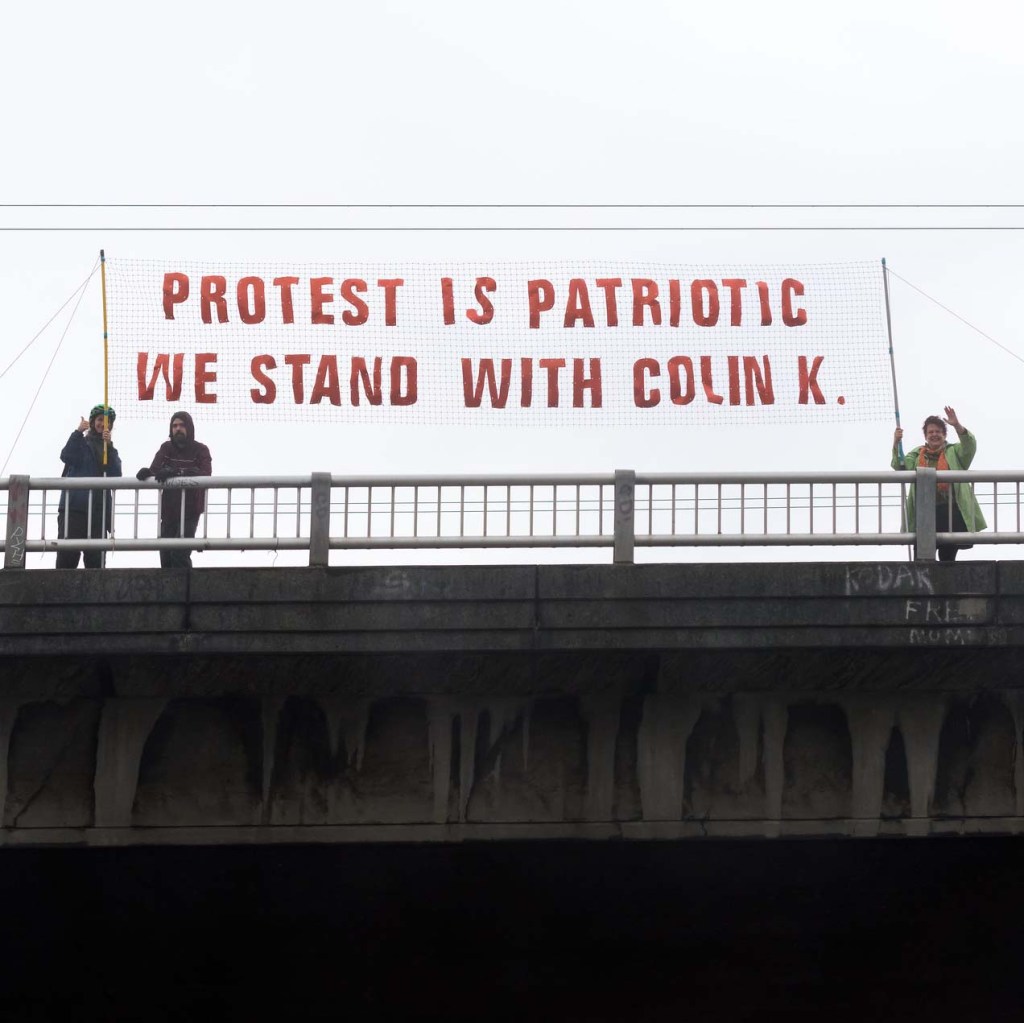
One of the problems is that whenever these athletes have stood up and tried to start conversations about racism, those conversations are often diverted into criticism of their actions. In some cases, athletes have been punished standing up for what they believe in. When they were being presented with their medals during the 1968 Summer Olympics in Mexico City, track and field athletes Tommie Smith and John Carlos raised their fists during the national anthem, and were quickly escorted out and had their medals confiscated soon after that. Boxer Muhammad Ali was a conscientious objector of the Vietnam War. He stated: “Why should they ask me to put on a uniform and go ten thousand miles from home and drop bombs and bullets on brown people in Vietnam, while so-called Negro people in Louisville are treated like dogs and denied simple human rights?” Ali refused to come forward when his name was called for the draft three times and was arrested. The New York State Athletic Commission suspended his boxing license and stripped him of his heavyweight title, other organizations quickly followed suit. At the game after Megan Rapinoe took a knee during the national anthem, the anthem was played while the teams were in the locker room so she couldn’t do it again. When swimmer Simone Manuel made history in Rio as the first black woman to win an individual gold medal, NBC didn’t air the medal ceremony, where she talked about the importance of the Black Lives Matter movement, until an hour after it happened.
Athlete and Civil Rights activist Jackie Robinson also refused to stand during the national anthem when he played baseball in the 1940’s and 50’s. As a black man in a white man’s world, Robinson’s decision to sit during a time of intense racial turmoil was incredibly brave, and people resented that bravery. When athletes use their celebrity to protest against America’s unfair treatment of minorities, the public is quick to express their disdain and denial that racism still exists. People who have criticized Kaepernick for not being black enough, poor enough, or oppressed enough are entirely missing the point that his protest was to be a voice for those without one. The idea that you have to be black and poor and oppressed to be an activist is completely ridiculous. People of privilege are in a uniquely powerful position to advocate on behalf of those without power.
Many athletes who don’t speak out about racial issues are put up on a podium for all of America to admire. Take O.J. Simpson. A former 49er and the first player in the NFL to rush 2,000 yards in a single season. He was a man who wanted to rid himself of his blackness, and mostly succeeded. O.J. wanted to be known as O.J., rather than a black man. He surrounded himself with white friends and never spoke up about issues of race in America. While Muhammad Ali protested the Vietnam War, when Rodney King was brutally beaten by Los Angeles police officers, when Martin Luther King Jr. was assassinated, O.J. was aggressively silent. The only thing he would say regarding these issues is that he wouldn’t say anything.
And the people loved him! Simpson never protested, never spoke up, and the public was happy with that. He maintained lucrative endorsement deals with companies like Hertz, RC Cola, and Wilson Sporting Goods. It wasn’t until O.J. went on trial for the murder of his wife and her friend, that he reclaimed his own blackness, and it was to save his own skin. So many black people are railroaded by the criminal justice system, and when O.J. wasn’t convicted, a large part of the black community was overjoyed. Many whites didn’t understand how he could be acquitted with what appeared to be overwhelming evidence against him.
When black athletes protest, they know that they’re going out on a limb because they’ll be treated differently than those who don’t speak out. These athletes saw injustice, and rather than ignoring it, they chose peaceful protest during the national anthem. It’s a moment when people feel proud of being American, and affirm that pride and respect by standing, pledging and singing. America has some things to be proud of, but that pride should not be blind. We have democracy, but we have never elected a woman for president. We have a free economy, but that economy has real and historic roots in the systemic oppression of black people. We have a powerful military, but we also have rampant gun violence. One of the founding principles of our country is that we have the right to be free in our expression. And we can disagree; where some see law and order, others see police brutality. Where some see a flag full of heritage, I see a symbol of the racist south during the Civil War. Colin Kaepernick was simply exercising his first amendment right to express his opinions through peacefully protesting the national anthem.
I don’t support the way this country has been built on the dehumanization of minorities and I don’t support how American society still benefits from the remnants of systemic oppression of people of color. I also peacefully protest. I don’t feel moved to make public displays of patriotism. I sit during the pledges, and I don’t sing the national anthem. I honestly don’t even know all of the words. I never have felt the need to pledge my allegiance daily to — when it comes down to it — a (symbolic) piece of fabric.
 meena anderson