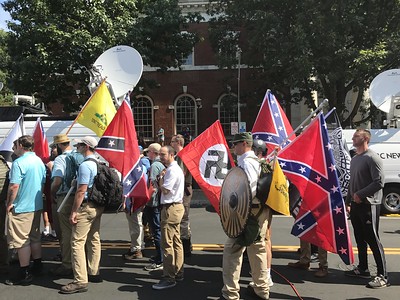
Opinion piece on the ‘Unite the Right’ Charlottesville rally in 2017.
Society has a problem with organization. People frequently ask me, “What are you?” or: “Why is your hair so curly?” or: “Where are your parents from?” We like to work in a system of checkboxes, where we all have specific criteria that people have to fit into. When people ask me these questions, that’s their way of figuring out who I am: not through my personality traits or political beliefs, but through my physical appearance.
The correct answer to all of those is “none of your business,” but in order to not come across as hostile or rude, I answer “mixed,” “because my dad has curly hair,” and “America.”
Boxes checked:
- Parents are different colors,
And if they’re extra observant:
- One parent is black.
The problem with this system is that once the boxes are marked, people are constrained to be two-dimensional stereotypes. This information people try to obtain when they ask those questions lacks depth, and the intention behind it isn’t anything more than trying to figure me out like a puzzle. The fact that my parents are different colors is irrelevant to my character. This information can be comforting—maybe it feels like a way to make a connection, to feel like you understand something about someone, but the danger is that it leads to stereotyping. And stereotyping, for some, is a short step away from hateful, harmful ideas and events, like in Charlottesville, Virginia in mid-August. A violence-filled weekend with white men carrying torches, marching two-by-two, and chanting phrases like “Jews will not replace us!” By the end of the weekend three people were dead, 35 were injured and white supremacy was worming its way out of the woodwork. Charlottesville served as the epicenter of an earthquake of tension and hate that rippled across the nation.
In the past couple of years leading up to this event, we’ve witnessed a global increase of hateful politics. A rise of overt white nationalism in America, anti-semitism and xenophobia making their way into the spotlight of European politics via Macron’s narrow victory, Erdogan’s consolidation of power in Turkey and Rodrigo Duterte’s war on drugs and the free press in the Philippines. Meanwhile, even mainstream politicians like Marine Le Pen, Geert Wilders and Teresa May all have an aggressive anti-immigration agenda. And our president, on the heels of Charlottesville, has not officially condemned the acts of the white supremacists in Charlottesville. These hateful politics have accumulated and spilled over into society: after the 2016 election, there was a significant rise in hate crimes according to data collected by the Southern Poverty Law Center (SPLC) and Shaun King, a writer, activist, entrepreneur and pastor. This hate has culminated in a violent explosion racism and aggression during that weekend in Charlottesville as white supremacists proudly walked the streets chanting nazi slogans.
The week before the rally, rumors buzzed on sites like twitter, Breitbart and various racist chat rooms about a protest, with no absolute confirmation from any white nationalists until the night of 11th when, according to the Washington Post, Richard Spencer (a prominent American white supremacist, and president of the National Policy Institute, a white nationalist think tank) texted a Washington Post reporter, telling them to be on the University of Virginia campus near “Nameless field.”
As reporters began to congregate near the site, they were met with a long line of white people holding tiki torches high in the air as they burned against the night sky, moving two by two, steps in sync, some with neutral expressions, some shouting into the cameras of news outlets filming them. The group, some 250 white supremacists strong according to The Washington Post, marched in a two-by-two formation to a statue of the University of Virginia’s founder, Thomas Jefferson. There, they were met with around 30 U-Va student counter protesters. Apart from one university police officer, there were no police arrived on the scene until several minutes later. By then, protesters and counter-protesters were punching and kicking, both counter protestors and white supremacists had been maced and chants of “white lives matter” began as a taunt to the protesting students.
Although this protest wasn’t much more than a rumor until the text from Spencer came in, as soon as the march began, authorities should have been arriving as quickly as reporters were.
Why weren’t the police monitoring this protest from the beginning? What did they think this was? A “dress-up-as-a-racist” party? A BYOT (bring your own torch) picnic? Clearly not. The lack of early police intervention evidences a deep-rooted problem within both the police system and American society: black people are seen as inherently violent and white people are not. If a couple of hundred black men armed to the teeth marched in the streets and held torches, the police and public’s reactions would’ve been significantly different. When a peaceful Black Lives Matter march happens, police in riot gear monitor protestors’ every move, but when a literal crowd of nazis chant racist slogans and carry weapons openly on a college campus, the police are late to the scene. This idea of black people being the perpetrators of violence in society is reinforced in popular culture; Fox News’ commentator Geraldo Rivera’s criticisms of rapper Kendrick Lamar’s opening number at the 2015 BET awards blamed hip hop lyrics instead of racism and police brutality for violence in and around the black community. Comedian Tina Fey said in a SNL skit:
“Part of me hopes these Neo-Nazis try it in New York City, like I hope they try it and get the ham salad kicked out of them by a bunch of drag queens because you know what a drag queen still is? A six-foot-four black man.” Because everyone should be afraid of a big black man, right? Raising the spectre of violence in this way, while well-intentioned, actually exacerbates the problem.
Even taking into account a year ago during the tumultuous Trump campaign, where it felt like racial tensions were constantly climbing and the left and right were getting farther apart, Charlottesville still felt like a slap in the face. A proud and threatening display of racism on such a large scale didn’t seem possible until it happened: much like the result of the 2016 election. It took the death of a white woman for a significant portion of America to be outraged at what’s going on in the political scene right now; yes, Charlottesville was atrocious, but plenty of other racist things have happened in recent years that have the caliber to also cause strong reactions, like the fatal shooting of nine black people by a white supremacist and Trump calling Mexicans “rapists” and criminalizing their existence through his “build a wall” rhetoric. We shouldn’t have been able to travel this far down the racism rabbit hole without bothering to look or listen to the signs (the president not distancing himself from the white supremacists that endorsed him on the campaign trail, for example) that something is gravely wrong.
 meena anderson