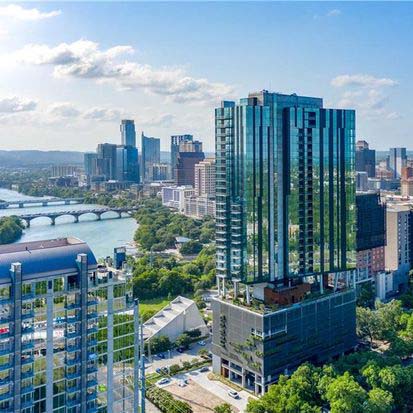
Rapid development of high rise condos in a historical Austin area proves problematic for residents.
Composed of three parallel streets nestled between Cesar Chavez Street, Interstate Highway 35 and Lady Bird Lake is Austin’s historical Rainey District. Cranes loom over lots as construction workers scale the scaffolding of soon-to-be high-rise condominiums. Residents walk dogs down the narrow sidewalk while other people enjoy mixed drinks outside bungalow-style bars and restaurants.
“Rainey Street is like its own little city within the city,” Anthony Martinez, lead concierge at Seventy Rainey, the newest high-rise on the street said. “Even though we’re downtown with the way that Rainey Street is set up, it’s like a backyard (get-together). Everybody is down here just having a good time.”
During the Oct. 31 Austin City Council meeting, more than 30 Rainey residents attended to express their frustration with the lack of sidewalk space and with pedestrian and vehicle congestion.
In 1884, Jesse Driskill and Frank Rainey divided the area between what is now Cesar Chavez Street and the Colorado River. Until the district was rezoned in 2005, Rainey was 120 acres of single-story houses, according to the National Register of Historic Places. After the rezoning, however, it has developed into a popular nightlife scene with bars, food trucks and restaurants. This has posed problems of population density within the district according to many Rainey residents, but many business owners have also been drawn to the area.
“There are way more people traveling to the area for tourism, people coming in here during the day looking for food and coffee and places to hang out,” Michael Johnson, general manager at Little Brother Coffee and Bar on Rainey Street, said. “I’m sure (new high-rises) can affect some people who live in the area, but for business, there’s nothing bad about increasing residents.”
Even before the rezoning of the Rainey District in the early 2000s, residents were worried about development of the area. In 1935, floods destroyed most of the original homes in the area. After the construction of I-35 in 1956, Rainey was isolated from most other residential areas in Austin. A 1978 report described more than half of the buildings on Rainey as “dilapidated.” In 1985, the district was added to the National Register of Historic Places because residents feared overdevelopment and exploitation of their neighborhood. The rapid development of Rainey after rezoning means current residents have similar fears to those who lived there in the 1960s and 70s.
“(Rainey) is landlocked, it’s already very crowded with a lot of people trying to move around and get in and out of their houses,” Rainey resident Staci Livesay said. “If we continue to add skyscraper after skyscraper, it’s only going to get worse.”
Other concerns the residents listed at the meeting included delivery trucks impeding traffic flow, electric scooters parked in inconvenient areas and increasingly narrow sidewalk space.
“We certainly have heard from the residents and business owners before today, they’ve been raising this as a concern for several years now,” City Council member Kathie Tovo said. “When we approved a zoning case, some of the residents were opposed initially, and they said they don’t want to see more development (on Rainey) without better mobility planning.”
Austin is the fastest-growing United States city according to the U.S. Census Bureau. Multiple condominium high-rises have appeared on Rainey Street in the past decade, including Skyloft that opened in Dec. 2013, the Camden that opened in 2018 and most recently, Seventy Rainey which opened in April 2019.
“We’re going from small houses and small bars to multi-level condos,” Skyloft concierge Chance Copeland said. “Now we’ve got buildings that are 33 stories, one’s coming up (and) it’s going to be 50 stories”
Rainey resident Trecia Roberts said she’s watched businesses and skyscrapers replace many of the bungalows that populated the street when she moved there 26 years ago.
“We can’t wait any longer,” Roberts said. “We’ve waited 10 years and we have nothing. I have been to (City) Council many times and done this session, and not one thing that we were talking about since 2016 has changed.”
Roberts said the ideal Rainey Street vehicular volume — a way to measure how many cars cross a section of road during a specified time period — is 9,000 cars. The vehicular volume on Rainey on a Saturday is 29,465 cars, according to the Town Lake Neighborhood Association. In early 2019, a pedestrian was hit by a car and severely injured on Rainey Street after a night out according to the Austin Police Department.
“It doesn’t seem like a good idea to have drunk people walking around the streets and also having dozens of cars going back and forth all day long,” Johnson said.
The Rainey District isn’t the only Austin neighborhood affected by rapid growth. Martinez said he welcomes newcomers to Austin and patrons to the Rainey District.
“As far as all the new developments (go), it’s like a double-edged sword,” Martinez said. “Some people like it, some people don’t. Know that we are changing our Austin skyline. Like I said, it’s only the beginning.”
 meena anderson